We spend a lot of time ensuring our structures are strong enough (hello, ULS!). But what about how they feel and perform day-to-day? That’s where Serviceability Limit States (SLS) come in. Sagging floors, cracked partitions, or that annoying bounce when someone walks by – these are all SLS concerns. The National Building Code of Canada (NBC) 2020 has brought SLS criteria more formally into the main body of the code (Article 4.1.3.4.), underscoring its importance.
Serviceability goes well beyond avoiding complaints; it’s about ensuring the building functions as intended, non-structural elements aren’t damaged, and occupants are comfortable. For those starting out, it’s a critical area to master beyond basic strength calculations. For the seasoned, it’s about appreciating the nuances, especially with modern, lighter construction.
Here’s what NBC 2020 says about SLS, focusing on deflection and vibration.
Why the Emphasis Now?
While serviceability has always been a design consideration, the NBC 2020 formally moved much of the guidance on SLS loads and load combinations from the commentaries directly into Article 4.1.3.4. and Table 4.1.3.4. (NBC2020-Commentary Commentary A, Paras 8, 51).
Why the shift?
- Modern Construction: As the commentaries note (Para 58), lighter, composite-acting construction often has less inherent stiffening and damping from things like heavy curtain walls or block partitions. This makes SLS checks, particularly for vibrations and deflections, more critical.
- Alignment: It aligns with international approaches (like ISO 2394) where serviceability gets similar billing to strength.
Design reminder: SLS isn’t an afterthought. NBC 2020 wants you to treat it with the same diligence as ULS.
Deflection: The Bend, Don’t Break (Too Much) Philosophy
Excessive deflection can lead to a host of problems: damaged finishes, misaligned components, ponding on roofs, or simply a structure that feels unsafe. NBC Article 4.1.3.5. lays out the requirements.
Key Considerations for Deflection Checks (Article 4.1.3.5.(1)):
- Intended Use: A warehouse floor and an office floor have different expectations.
- Non-Structural Elements: Will your deflections crack drywall, jam doors, or break window seals? You need to limit damage to these elements if their properties are known at design time.
- Structural Damage: Of course, deflections shouldn’t damage the structure itself.
- Long-Term Effects: This is a big one! Creep, shrinkage, temperature changes, and pre-stress all need to be factored in.
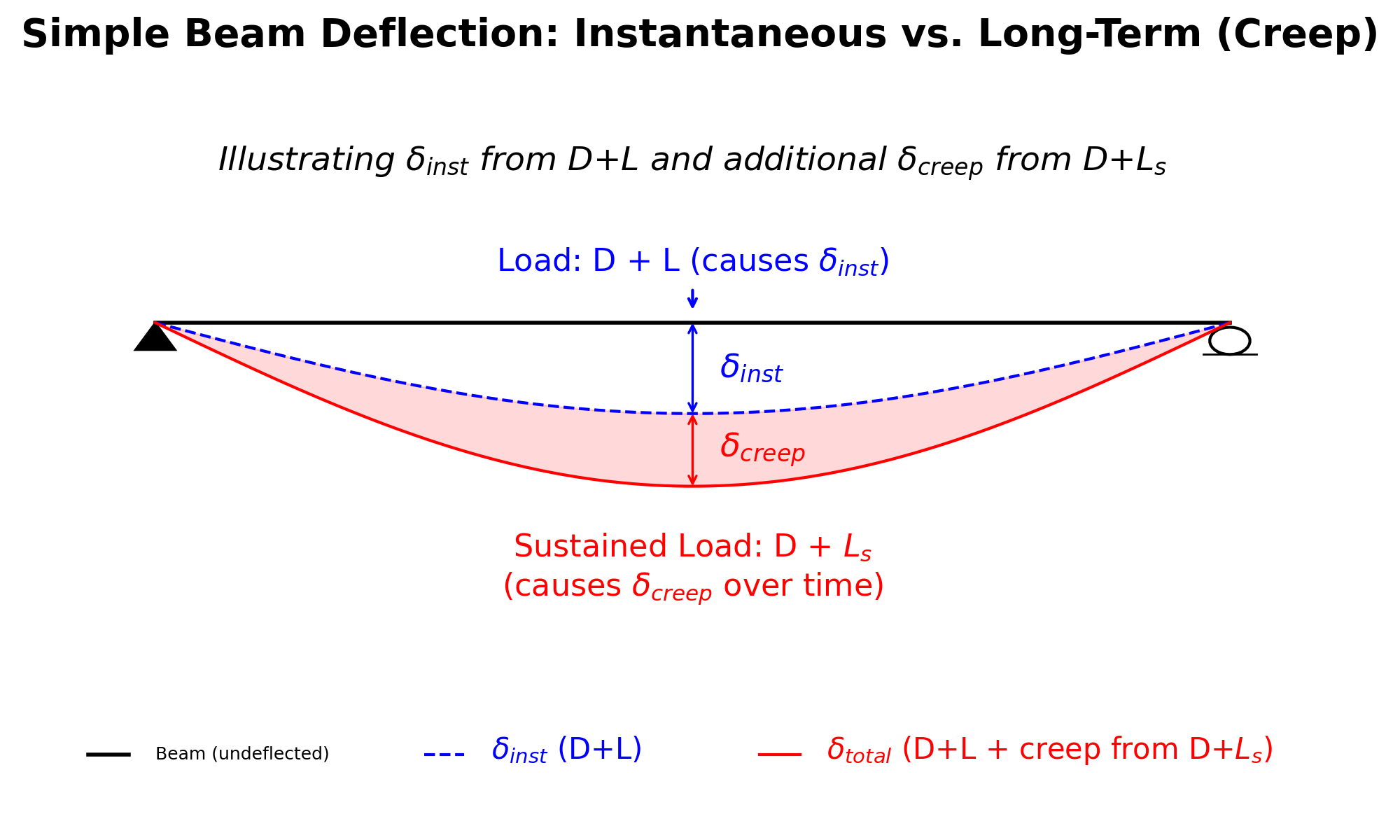
Differentiating Live Loads for Creep (Article 4.1.3.4.(5)): For materials prone to creep (like concrete and wood), you need to get specific about your live loads:
- \(L_s\) (Sustained Live Load): The portion of live load that’s effectively permanent (e.g., heavy furniture, permanent storage, fixed equipment). This contributes to long-term creep deflection.
- \(L_t\) (Transient Live Load): The portion that comes and goes (e.g., people walking, temporary storage).
The calculated deflection from Dead Load (D) and Sustained Live Load (\(L_s\)) must be beefed up by a creep factor as per the relevant material standards (CSA A23.3 for concrete, CSA O86 for wood) to find the additional long-term deflection.
In practice: Don’t just use total live load for all deflection checks, especially when dealing with creep-sensitive materials. Understanding \(L_s\) versus \(L_t\) is crucial. The commentaries (NBC2020-Commentary Commentary A, Para 52) explain that the proportion of \(L_s\) varies by occupancy – a corridor is mostly \(L_t\), while an equipment room will have a higher \(L_s\).
Lateral Deflection (Drift):
- Buildings need to be checked for lateral deflection under service wind and gravity loads to prevent damage to structural and non-structural elements (Article 4.1.3.5.(3)).
- The general limit for total drift per storey is 1/500 of the storey height, unless design standards specify otherwise or for certain industrial buildings where greater movement is acceptable.
- Don’t forget earthquake drift checks as per Article 4.1.8.13! (Though that’s often a ULS check with SLS implications).
Where to Find Deflection Limits? While the NBC sets the general framework, specific deflection limits are often found in the material design standards (CSA S16 for steel, A23.3 for concrete, O86 for wood) or an appendix in the code. Note A-4.1.3.5.(1) (NBC2020) points to these standards and the “Deflection and Vibration Criteria” commentary.
Vibration
Nobody likes a bouncy floor or a building that sways uncomfortably in the wind. Article 4.1.3.6. addresses vibration serviceability.
General Requirement (Article 4.1.3.6.(1)): Floor systems susceptible to vibration must be designed so vibrations don’t “have significant adverse effects on the intended occupancy.” This is a bit subjective, which is why more specific guidance exists.
When is Dynamic Analysis a Must?
- Machinery/Equipment (Article 4.1.3.6.(2)): If you anticipate resonance between floor vibrations and operating machinery, a dynamic analysis is required. Think large fans, pumps, or industrial equipment.
- Rhythmic Activities (Article 4.1.3.6.(3)): For assembly occupancies like dance floors, concert venues, gyms (jumping exercises, gymnastics), if the floor’s fundamental vibration frequency is less than 6 Hz, you must investigate resonance effects via dynamic analysis.
- Lateral Vibration from Wind (Article 4.1.3.6.(4)): Buildings prone to lateral sway under wind need to be designed per Article 4.1.7.1. to avoid adverse effects.
Design reminder: Static deflection checks might not be enough for vibration-sensitive floors. The NBC pushes for dynamic analysis in specific, higher-risk situations. The “Deflection and Vibration Criteria” commentary and resources like the AISC Design Guide 11 (for steel) are invaluable here.
Loads for Serviceability Checks (Table 4.1.3.4.): This table in the NBC 2020 specifies load combinations for various serviceability checks. For example:
- For vertical deflection due to gravity loads: Often \(D + L\), or \(D + S\).
- For effects of temperature: \(D + T\).
- For lateral deflection due to wind: \(D + W\) (or \(0.9W\) for some checks).
- The Importance Factors (\(I_S, I_W, I_E\)) for SLS are typically 0.9 or 0.75 (as per Table A-2 in the Commentaries), reflecting the lower consequence of exceeding an SLS limit.
The commentary (NBC2020-Commentary Commentary A, Para 53) clarifies that for vibration serviceability, you don’t usually need to combine loads. However, for assessing potential damage to brittle components, load combinations might be necessary.
Pulling It Together
Serviceability isn’t just about meeting code minimums; it’s about creating structures that perform well over their lifespan and provide a comfortable, safe environment for occupants. The NBC 2020’s refined focus on SLS, particularly deflection and vibration, is a reminder that our designs have a direct impact on user experience.
Pay attention to:
- The specific requirements in Articles 4.1.3.4, 4.1.3.5, and 4.1.3.6.
- Differentiating \(L_s\) and \(L_t\) for creep.
- The triggers for dynamic analysis for vibrations.
- The guidance in the Structural Commentaries and your material design standards.