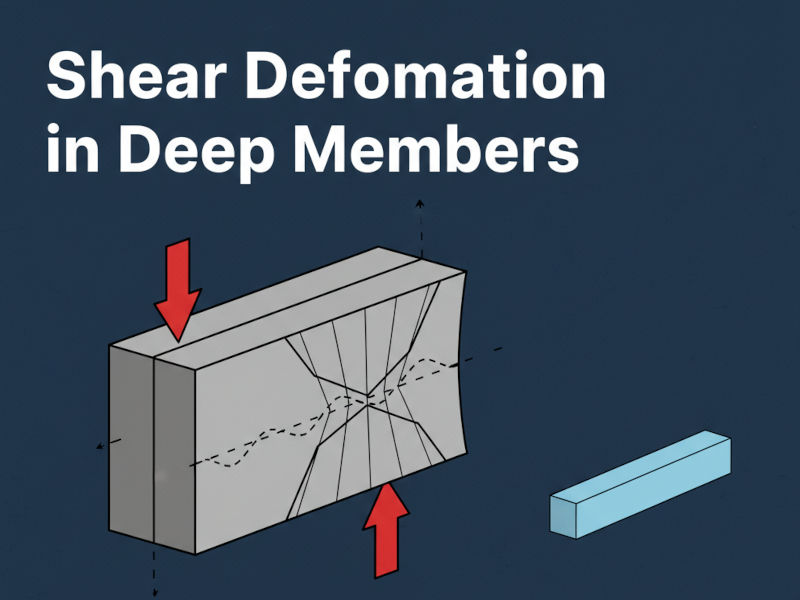
Most of the time, our building beams are slender enough that shear deformation is an afterthought. We worry about flexural stiffness, slap on a deflection limit, and move on. But as soon as you start working with deep transfer girders, perimeter spandrels, or short plate girders, ignoring shear deformation can quietly under-predict drift and member demand.
If you’ve spent time thinking about when to trust simple frame models versus full FEA in Frame Stiffness vs FEA, building substitute frame models for preliminary design, or how to tune your model in What to Change in Your Structural Model to Gain Real Confidence, shear deformation is a natural next refinement. The discussion here focuses on when it actually matters, how to quantify it, and how to get your stiffness right in practice.
This is not about shear strength checks. It’s about how shear deformation affects serviceability, internal force distribution, and modelling accuracy in deep members.
1. Shear deformation vs “ordinary” beam deflection
Classical Euler–Bernoulli beam theory assumes that plane sections remain plane and normal to the neutral axis after bending. In other words, it assumes no shear deformation—cross-sections don’t “slide” relative to each other. For most building beams, this is perfectly adequate.
Timoshenko beam theory relaxes that assumption: plane sections remain plane, but they are allowed to rotate independently from the slope of the deflection curve. The difference shows up in the total deflection.
For a simply-supported beam with a center point load, the total mid-span deflection can be written as:
Flexural part:
$$ \delta_b = \frac{PL^3}{48EI}$$Shear part:
$$ \delta_s = \frac{PL}{4A_v G} $$
where:
- \(E\) is Young’s modulus
- \(G\) is shear modulus (≈ 0.4E for steel, ≈ 0.4E for concrete at service)
- \(A_v\) is the effective shear area (not the gross area)
The key observation is that:
- Flexural deflection scales with \(L^3\)
- Shear deflection scales with \(L\)
So as members get shorter (smaller \(L\)), the flexural term decays much faster than the shear term, and shear deformation becomes a larger fraction of the total.
The ratio between shear and flexural deflection for this case is:
$$ \frac{\delta_s}{\delta_b} = \frac{12EI}{A_v G L^2} $$
This simple expression is the backbone of all the rules of thumb in the next section.
2. When does shear deformation become significant?
Your goal is not to chase the last fraction of a millimeter of deflection; it’s to know when neglecting shear changes the engineering decision. A practical rule is:
Treat shear deformation as significant once it contributes more than about 5–10% of the total deflection in the critical limit state.
Using the simply-supported beam ratio and a rectangular section with \(A_v \approx \tfrac{5}{6}bh\) and \(I = \tfrac{bh^3}{12}\), we can write:
\[ \frac{\delta_s}{\delta_b} \approx 3.0 \left(\frac{h}{L}\right)^2 \]for typical steel or concrete (E/G ≈ 2.5–2.6 and \(\kappa \approx 5/6\)).
This leads to very useful ballpark guidance:
- \(L/h \gtrsim 12\): shear deflection is typically around 2% of flexural deflection – safely negligible for most building beams.
- \(8 \lesssim L/h \lesssim 12\): shear may contribute 2–5% – worth checking if drift is tight or deep girders control.
- \(L/h \lesssim 8\): shear can contribute 5–10%+ of total deflection – treat the member as “short” for deformation.
- \(L/h \lesssim 4\): you are squarely in deep-beam territory; shear deformation and disturbed regions near supports dominate behaviour and code provisions often shift toward strut-and-tie models.
From a modelling perspective, members where shear deformation is likely to be important include:
- Deep plate girders in transfer levels or long-span roofs
- Perimeter spandrel beams in moment frames, especially if architectural constraints force large depths
- Short coupling beams and deep spandrels between shear walls
- Any member carrying a large point load close to a support, producing high shear relative to bending moment
Whenever you see these geometries, make “include shear?” a conscious modelling decision instead of a default.
3. Effective shear area \(A_v\) for common cross-sections
Most commercial frame programs already implement Timoshenko beam theory internally. What you control is the shear area \(A_v\) (sometimes entered separately about the local 2- and 3-axes). Using the gross area is tempting, but wrong—shear stress is not uniform over the section.
The standard approach is:
\[ A_v = \kappa A \]where:
- \(A\) is the gross area
- \(\kappa\) is a shear correction factor depending on section shape and the shear direction
3.1 Rectangular (concrete or steel plates)
For a solid rectangular section of width \(b\) and depth \(h\) under in-plane shear:
\[ A_v \approx \kappa A \approx \frac{5}{6}bh \]This is the textbook result for a parabolic shear-stress distribution. For reinforced concrete beams, using the gross concrete section for stiffness (even if you use a reduced section for strength checks) is usually reasonable; the longitudinal reinforcement does not significantly change the shear stiffness at service.
3.2 I-shaped sections and plate girders
For wide-flange sections and plate girders bending about their strong axis, shear is carried primarily by the web. Code provisions and steel texts commonly approximate the effective shear area as the web area, with small adjustments for rolled shapes. A simple, practical set of rules is:
- For rolled I- or H-shapes, use
\[ A_v \approx 1.0\,d_w t_w \] where \(d_w\) is the clear web depth between fillets and \(t_w\) is web thickness. - For welded plate girders with a single web,
\[ A_v \approx d_w t_w \] - For box girders with two webs, sum both web contributions:
\[ A_v \approx d_{w1} t_{w1} + d_{w2} t_{w2} \]
In all cases, you’re asking: which parts of the section actually carry shear? For major-axis bending, it’s almost entirely the webs. These are stiffness-side approximations: they typically underestimate \(A_v\) slightly, which is conservative for stiffness (you get a bit more shear deformation than in reality).
3.3 Channels, tees, and angles
For channels and tees bending about the strong axis, you can treat them much like a “half I-section”: the web carries most of the shear and the flanges contribute modestly. Using:
\[ A_v \approx 0.8\,d_w t_w \]is usually a ballpark value—acceptable for stiffness modelling provided the web is not heavily perforated. For legs of angles loaded in shear, most software manuals provide recommended \(\kappa\) factors; adopting those values keeps your model consistent with the element formulation. If the member is critical, check against a steel manual rather than relying on this rule of thumb.
3.4 Hollow structural sections (HSS)
For square and rectangular HSS, shear is carried around the entire perimeter, but the corners and local bending reduce the effective area. Typical approximations are:
- Square/rectangular HSS:
\[ A_v \approx 0.6–0.7\,A \] - Circular hollow sections (CHS):
\[ A_v \approx 0.5–0.6\,A \]
When in doubt, check your preferred steel design manual or program documentation—many provide tabulated shear areas specifically for use in Timoshenko elements.
4. How the stiffness matrix changes when you include shear
If you are assembling stiffness matrices yourself (or just want to understand what your software is doing under the hood), it’s helpful to see how shear deformation modifies the familiar 4×4 bending stiffness sub-matrix.
Define the non-dimensional parameter:
$$ \Gamma = \frac{12EI}{A_v G L^2} $$For a prismatic Timoshenko beam element with two rotational degrees of freedom per node (no axial DOF), the local bending stiffness matrix can be written as:
$$ \mathbf{k}_b = \frac{EI}{L^3(1+\Gamma)} \begin{bmatrix} 12 & 6L & -12 & 6L \\ 6L & (4+\Gamma)L^2 & -6L & (2-\Gamma)L^2 \\ -12 & -6L & 12 & -6L \\ 6L & (2-\Gamma)L^2 & -6L & (4+\Gamma)L^2 \end{bmatrix} $$What does \(\Gamma\) actually mean?
- For the simply-supported, center point load case we started with,
\[ \Gamma = \frac{12EI}{A_v G L^2} = \frac{\delta_s}{\delta_b} \] so it is literally the ratio of shear to flexural deflection for that loading. - Stiffness is the inverse of deflection, so in that case
\[ \frac{K_b}{K_s} = \frac{48EI/L^3}{A_v G/L} = 4\Gamma \] i.e. \(\Gamma\) is proportional to the flexural-to-shear stiffness ratio.
So \(\Gamma\) is best thought of as a non-dimensional measure of relative shear flexibility: larger \(\Gamma\) means shear deformation is more important compared to bending.
Key observations:
- If you let \(A_v \to \infty\), then \(\Gamma \to 0\) and you recover the familiar Euler–Bernoulli matrix.
- As \(A_v\) decreases (more shear flexibility), \(\Gamma\) grows and the bending terms soften.
- Many frame programs expose this only through the shear area inputs; internally they’re using some variant of this matrix.
For full 2D or 3D beam elements, this bending matrix is combined with the axial stiffness term \(EA/L\) and, in 3D, torsional terms. The important point for practising engineers is that getting \(A_v\) right is equivalent to getting the shear part of the stiffness matrix right.
5. Plate girders and spandrel beams: practical modelling tips
Deep plate girders and spandrel beams are exactly where shear deformation can slip past a “good enough” model and materially affect your design decisions.
5.1 Plate girders and transfer girders
Consider a steel plate girder with span \(L\) and overall depth \(h\). Using the general relationship:
\[ \frac{\delta_s}{\delta_b} \approx C\left(\frac{h}{L}\right)^2 \]you can quickly sanity-check whether shear is important.
For a solid rectangular section we saw that \(C \approx 3\). Plate girders are not rectangles: \(I\) is dominated by the flanges, while \(A_v\) is dominated by the relatively thin web. When you plug in real section properties (using web-based \(A_v\)), you typically get much larger \(C\) values, often in the range:
\[ C \approx 8\text{–}10 \]for thin-web, deep plate girders and rolled wide-flange sections acting as girders.
That has big consequences. As a rough feel for plate girders with \(C \approx 8\text{–}10\):
- \(L/h = 6\): \(h/L \approx 0.17 \Rightarrow \delta_s/\delta_b \sim 25\text{–}30\%\)
- \(L/h = 4\): \(h/L = 0.25 \Rightarrow \delta_s/\delta_b \sim 45\text{–}60\%\)
- \(L/h = 3\): \(h/L \approx 0.33 \Rightarrow \delta_s/\delta_b \sim 70\text{–}100\%\)
Those are back-of-envelope numbers, not design checks. The point is qualitative:
For real plate girders, shear deformation can easily be on the same order as flexural deformation once \(L/h\) drops into the 3–6 range.
For transfer girders and heavily loaded plate girders:
- Use a Timoshenko beam formulation (most programs will call this a “beam with shear deformation”) and input a realistic \(A_v\) based on the web(s).
- Check both vertical deflection and rotational compatibility with supported columns or walls; extra shear deformation can increase rotations more than you might expect.
- Run a sensitivity case with shear deformation turned off to understand how much it’s contributing to total deflection and internal force redistribution.
If the sensitivity run tells you shear is contributing 20–40% of total deflection or noticeably redistributing forces, you’re in a regime where you must keep shear deformation in the model.
5.2 Spandrel beams in moment frames
Perimeter spandrel beams in steel or concrete moment frames are often relatively deep, architecturally constrained members sitting at the edge of diaphragms. They may have:
- Low span-to-depth ratios (particularly in high seismic zones where beams are deepened for strength and ductility)
- High shear from combined gravity and lateral loads
- Loads concentrated near supports (e.g., from façade elements or transfer of slab shear)
If you model these beams without shear deformation, you can unintentionally:
- Underestimate frame story drift (because the spandrel is stiffer than reality)
- Underestimate end rotations and joint demands, which affects detailing at beam–column joints
- Misjudge the distribution of bending between beams and columns
A good workflow is:
- Start with a conventional model (Euler–Bernoulli beams) to understand the basic load paths.
- Identify deep spandrels (say \(L/h \leq 8\)) that are part of the lateral load-resisting system.
- Switch these members to beam elements with shear deformation, supply realistic shear areas, and re-check story drifts and joint demands.
- If demands shift materially, keep shear deformation in your final model and document the sensitivity study as part of your design record.
5.3 Don’t “turn on everything everywhere”
It’s tempting to simply enable shear deformation for every beam in a model. That’s rarely necessary, and it can mask the very sensitivity you’re trying to understand. A more disciplined approach is:
- Use shear-deformation beams selectively where the geometry and loads justify it.
- Keep a simpler reference model without shear deformation for comparison.
- Document the differences—this is a kind of effective, transparent modelling.
6. Bringing it all together
Shear deformation is one of those effects that matters enormously in a few key places and hardly at all elsewhere. The trick is to recognize those places quickly:
- Look at span-to-depth ratio and proximity of loads to supports.
- Compute or estimate effective shear areas rather than relying on gross section properties.
- Understand that changing \(A_v\) is, in practice, how you are changing the shear part of the stiffness matrix.
- Use targeted sensitivity studies on plate girders, spandrels, and deep coupling beams to decide whether shear deformation belongs in your final design model.
Handled this way, shear deformation becomes a tool to improve confidence in your model—not an excuse to build an unnecessarily complicated one.