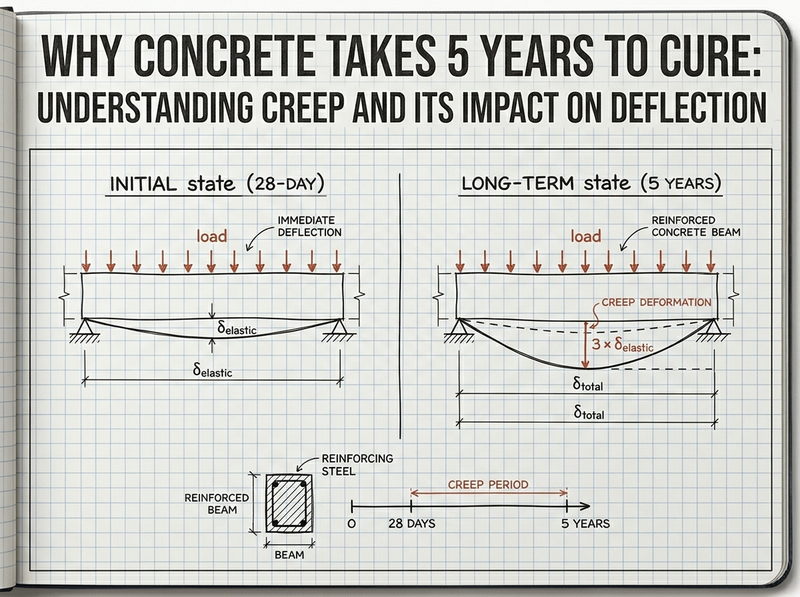
Ever poured a concrete slab, checked the deflection at 28 days, and called it done? That slab will keep deflecting for the next five years - even with nothing added to it.
The name for this is creep. It’s a fundamental property of concrete, and ignoring it sets you up for cracked drywall, ponding roofs, and conversations with building owners you don’t want to have. Or their lawyers.
The 5-Year Reality Check
Concrete reaches design strength at 28 days - mostly. What gets less attention is that curing continues for years afterward.
Think of it as glue holding marbles together (your aggregate). At placement, the glue is wet. At 28 days, you’ve got roughly 70% of ultimate strength. The cement paste keeps hydrating, hardening, and changing properties for approximately five years before it stabilizes.
The 28-day test tells you the concrete meets spec. It doesn’t tell you how the structure behaves over its service life.
Two things follow from this extended curing:
- Shrinkage - as cement cures, it loses moisture and contracts
- Creep - under sustained load, the not-yet-hardened concrete keeps deforming
Creep is the one that catches engineers off guard.
What Exactly Is Creep?
Chew a piece of taffy. Pull it, hold it - it keeps stretching even though you’re not pulling any harder. That’s what creep does to concrete.
Creep is the time-dependent deformation of concrete under sustained stress. Unlike elastic deformation, which is instant and reverses when you remove load, creep accumulates continuously even when load stays constant.
Load a slab to service condition on day one. Come back two years later and it’s deflected significantly more - with nothing added to it.
The mechanism is in the cement paste, which hasn’t fully hardened yet. Under sustained compression, that semi-cured material deforms slowly. Aggregates don’t creep much; the paste surrounding them does, and that’s enough to cause meaningful structural movement.
The Creep Curve: What to Expect Over Time
Creep follows a consistent pattern:
- First 28 days: Rapid development - roughly 70% of total creep occurs
- 28 days to 1 year: Continued creep at a declining rate
- 1-5 years: Gradual leveling as concrete approaches full cure
- After 5 years: Creep stops as cement paste stabilizes
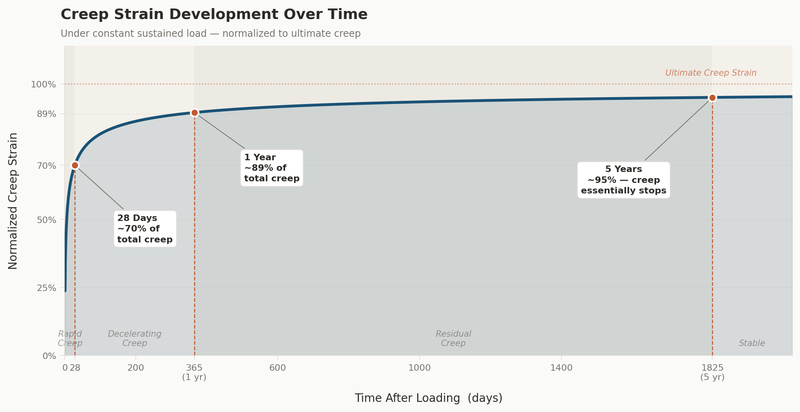
Check deflection at 28 days and you’ve captured about 70% of the creep that will eventually occur. Another 30% is still coming.
The Rule of Three: Estimating Long-Term Deflections
A practical rule of thumb:
Expect long-term deflection under sustained load to be approximately three times the instantaneous elastic deflection.
This multiplier of ~3 accounts for the initial elastic deflection and the creep that accumulates over years. A slab that deflects 10 mm when forms strip will reach roughly 30 mm under sustained dead load.
CSA A23.3 provides more refined time-dependent calculations, but “triple your elastic deflection” is a reliable starting point for quick checks and preliminary design.
Why This Matters for High-Rise Construction
High-rise concrete schedules run fast. A typical cycle:
- Concrete poured for a floor
- Forms stripped 4-7 days later
- Crew moves up, starts forming the next floor
- Repeat, one floor per week or faster
At 4-7 days, that slab is nowhere near 28-day strength, let alone its long-term properties. It’s already carrying its own weight (roughly 100 psf for an 8-inch slab ), construction loads from above, and forms and shores for the next floor up.
Concrete at that age is soft when it takes on load. Early creep is more aggressive because the paste is more deformable. Deflections accumulate floor by floor before anyone runs a post-construction check.
Walk a high-rise site during construction and you’re looking at a structure that’s already been load-tested beyond normal service loads. Every slab has carried significant construction loading at early age.
From a strength standpoint, that’s not a problem - if the structure survived construction, it’s proven capacity. But for serviceability, deflections have been accumulating since the paste was at its softest.
Factors That Make Creep Worse
Not all concrete creeps equally. Several factors push it higher:
High water-cement ratio leaves more unreacted water to evaporate, weakening the paste matrix and making it deform more easily under sustained load.
Poor curing - too fast, too hot, or too cold - compromises hydration. You get concrete that’s weaker and creeps more.
Early loading accelerates creep when paste is still soft. In fast construction schedules this is unavoidable; account for it in design rather than assuming ideal timing.
High sustained stress relative to concrete strength drives creep rate directly. Push the material harder and it deforms more over time.
Temperature matters more than engineers usually account for. A parking structure in Phoenix creeps more than the same structure in Vancouver.
Serviceability: Where Creep Complaints Come From
If you’re going to get sued over concrete design, it’s probably a serviceability issue, not a strength failure.
Strength failures are rare - we use conservative factors, concrete often comes in stronger than specified, and cast-in-place construction has redundant load paths. Serviceability problems are common.
You’ve designed a floor slab that meets every code requirement. Structurally sound. But over time, it deflects under dead load, drywall is attached directly to the underside, the ongoing movement cracks it, the owner sees cracks, and a lawyer sends you a letter.
You didn’t make a mistake - concrete behaves this way. But if you didn’t communicate expected deflections to the architect, or detail for movement, the conversation is still yours to have.
Common mistake: treating deflection as a purely structural question. Long-term deflections affect everything attached to the structure - drywall, partitions, mechanical equipment, floor drains that no longer slope where they’re supposed to.
Practical Guidance for Your Designs
Use long-term deflection, not just immediate
When checking against serviceability limits, use the long-term value. CSA A23.3 provides time-dependent calculation methods that cover both creep and shrinkage. Running only the instantaneous check gives you a number that’s roughly one-third of what the structure will actually see.
Account for the loading timeline
Finishes installed at 28 days will experience the deflection that occurs afterward. That incremental deflection - not the total - is what cracks drywall and jams doors. Map out when each finish goes in and compare that against the deflection curve; the gap between installation date and final deflection is your exposure.
Detail for movement
Slip connections, expansion joints, and isolation details let the structure move without transferring that movement into finishes. Work with the architect early; this is a coordination issue as much as a design one.
Specify camber on critical spans
For long-span beams or slabs where deflection is critical, specify an upward offset built into the formwork. The structure sags toward level rather than past it.
Write clear specifications
If the design is sensitive to early stripping or construction loading sequence, say so explicitly. Delaying form removal by a few days or controlling when loads are applied can meaningfully improve long-term serviceability.
The Bottom Line
Concrete keeps changing for years after placement. Creep is why deflections roughly triple over time under sustained load - not a defect, not unusual behaviour, just how the material works.
For Canadian engineers working under CSA A23.3: check both immediate and long-term deflections, coordinate those expectations with the architect before finishes are detailed, and write specifications that give the construction team a realistic shot at delivering the serviceability performance your design depends on.
On your next project, run the numbers both ways. Then look at the detailing drawings and find the finishes attached directly to elements that will keep moving. That’s where the complaints start.